YouScript Now a Verified Company with HealthXL

By News, Personalized Medicine, Press Releases

YouScript, a life-saving clinical decision support tool, aiding enterprise health solution providers in reducing the adverse drug event epidemic.

YouScsript HealthXL VerifiedSeattle, WA — (July 26, 2017) — YouScript is now a verified company with HealthXL , a global organization driving innovation in healthcare through an elite network of healthcare executives and global solutions. Companies can only obtain verified status when there is evidence that their product has a positive clinical or commercial impact. YouScript is a disruptive technology tackling the monumental adverse drug event crisis in the US today which claims a life every 5 minutes and causes billions of preventable healthcare costs.

YouScript’s CEO Kristine Ashcraft is part of the global advisory network to develop innovative and meaningful connections and solutions for some of healthcare’s biggest challenges. HealthXL created a network of incubation, live events, and a platform on equal ground from new ventures to established players in healthcare.

“Although our technology has been shown to reduce readmissions, ER visits, and deliver cost savings in as little as 60-days, YouScript’s challenge lies in reaching the right stakeholders in a complex system. HealthXL helps us reach thought leaders that are adopting solutions that help them meet the Triple Aim,” said Ashcraft. “I am very excited to join HealthXL and develop meaningful partnerships with these leaders in healthcare.”

Starting initially as an accelerator program, HealthXL connects payors, technology solution providers, device manufacturers, health providers, and other industry professionals with a platform to engage in information exchange. By utilizing this shared platform, companies can identify leaders, innovators, and investors.

HealthXL partners and key members:

  • Cleveland Clinic
  • Highmark Health
  • Novartis
  • Johnson & Johnson
  • IBM
  • EY

Ashcraft is using the network to connect with key industry leaders to bring YouScript’s solutions to their problems, and finding new resources to solve challenges YouScript faces. “HealthXL provides us the opportunity to make connections that will greatly aid in our capacity to improve patient care and bend the healthcare cost curve as the benefits of precision medicine are realized in the market,” said Ashcraft.

Gauging the Impact of Disruptive Innovation

By Clinical Decision Support Tool, Health Care IT, News

Disruptive innovation refers to an innovation that creates a new market and value network and eventually disrupts an existing market and value network, displacing established market leading firms, products, and alliances.1
Innovation

Consider this — when digital cameras were new, was the leading film company innovating in this digital space? With a large shift in how consumers capture, share, and store pictures, Kodak held fast to less innovative technologies. Several small disruptive innovators came in and turned image capturing on its head and changed the industry forever.

Healthcare is ripe for disruptive innovation to improve outcomes, provide increased value, and increase safety. In an industry filled with research, innovation, and technology, the ground is set for new health innovations.

A brief history of disruptive healthcare innovations:

  • Handwashing
  • Oranges for scurvy
  • Iodine in salt
  • Golden hour
  • Electronic Medical Records

Before each of these innovations became standard practice, the doctors and scientists were considered crazy for bucking the status quo. “If it worked before, why do we need to change it?” was heard across the medical community each time a disruption surfaced.

But, what if clinically proven, research-focused healthcare disruptions improved the triple aim and met the Hippocratic oath to do no harm?

Clinical decision support tools are critical to the success in the modern hospital and clinic.2 The translation of clinical knowledge into useable and curated elements of the continuity of care is monumental in proper patient care.

In the end, disruptive innovation will continue to push healthcare forward, create opportunities for growth, and change how we treat patients.

  1. https://hbr.org/1995/01/disruptive-technologies-catching-the-wave
  2. https://healthit.ahrq.gov/ahrq-funded-projects/current-health-it-priorities/clinical-decision-support-cds

YouScript at the Long Term Post Acute Care & HIT Summit

By Events, Health Care IT, News

YouScript CEO Kristine Ashcraft attended the Long Term Post Acute Care & HIT Summit this week in Baltimore, MD to present a talk on the implications of pharmacogenetic testing, polypharmacy, and its impact on the elderly.

The presentation Kristine gave was titled “Integration and Outcomes: Shifting Precision Medicine from the Future to Now”
LTPAC HIT

Many in healthcare today consider precision medicine and pharmacogenomics something that will be of benefit in the future, especially outside of oncology. Healthcare systems are juggling multiple implementations and making major process changes to address the shift to value-based care. All this with a careful eye on the associated and constantly evolving regulatory and quality initiatives. The only way to rise above the noise is to provide proven clinical and financial benefits AND answer the key questions – who do we test and how do we act on it – within the clinical workflow. See new research that puts pharmacogenetics on the priority list in a value-based world, and learn how cumulative and gene-based interaction risk is being identified and managed in the EHR.

The LTPAC Health IT Summit is hosted by the LTPAC Health IT Collaborative including AHIMA, the American Association of Nurse Assessment Coordination; the American Medical Rehabilitation Providers Association; the American Health Care Association; the National Center for Assisted Living; LeadingAge; the Center for Aging Services Technologies; Healthcare Information and Management Systems Society; the National Association for Home Care and Hospice; the National Association for the Support of Long Term Care; the National Pace Association; the American Society for Consultant Pharmacists; and the Home Care Technology Association of America.

This Month in Pharmacogenetics and HealthIT – February 2017

By Health Care IT, Personalized Medicine, Pharmacogenetics, Recommended Links

Pharmacogenomics and Precision Medicine is trending like never before, with the strides that are being made in this field. While you can go and search out the news yourself, we want to make it easy for you. You can start by following social media platforms: Facebook, Twitter, Pinterest, and LinkedIn. We’re constantly posting relevant articles from around the web. Or you can follow our “This Month in Pharmacogenetics and HealthIT” series where we highlight some of the current trending articles. Here’s this month’s trending articles:

Genomics, Clinical Decision Support Combo Cuts ED Visits by 42%
“Providers who combined genetic testing with a clinical decision support tool to treat home health patients using multiple medications were able to reduce hospital readmissions by 52 percent and cut ED visits by 42 percent, according to a study published in PLOS ONE.”

What the future might hold for EHRs
“While there is still plenty of room for improving the usability of electronic health records (EHRs) and making them more affordable for care providers, experts are trying to get folks to focus on their future potential. The barriers to EHR implementation and interoperability are slowly coming down and once they do, vendors will start looking to add more functionalities to the systems.”

Polypharmacy: Keeping the elderly safe
Reducing and managing polypharmacy is a key factor to reducing hospital readmissions and ED visits. YouScript can help through our drug auditioning tool, no other software on the market right now can offer this assistance.

Breaking Down the Basics of the Patient-Centered Medical Home
“As the healthcare industry moves away from traditional fee-for-service reimbursements towards a new era of accountable, cost-conscious, coordinated care, healthcare organizations are actively seeking new patient management strategies to meet stringent quality and spending goals.”

HIMSS17 Highlights The Year Of Precision Health
“HIMSS is calling 2017 the year of Precision Health, making it a major focus of this year’s HIMSS Annual Conference in Orlando, Feb. 19-22. This year’s sessions will focus on the patient through the use of healthcare analytics and collaboration, highlighting the customization of actions now possible through innovative technology.”

YouScript at HIMSS 17 Wrap-Up

By Events, Health Care IT, News, Personalized Medicine

We had a fantastic time in sunny, warm, Orlando, FL last week at HIMSS 2017! The YouScript team made amazing connections, met some friends, made new ones, and continued to champion precision medicine to a captive health IT audience.

Did you get a chance to spin our wheel and take a demo of our precision prescribing software? If you missed out, our inboxes are always available. Here are just a few reasons why you should send us an email.

4 Reasons to Talk to YouScript:

  1. We provide an at-a-glance user interface enabling faster, smarter polypharmacy management. YouScript holistically analyzes the impact of a patient’s genetics, drug profile, OTC, and herbals in a live, dynamic environment quickly identifying patients that will benefit from pharmacogenetic testing and those at highest risk for adverse drug events.
  2. Our approach has been shown to substantially reduce readmissions, ED visits, and healthcare costs in multiple studies.
  3. You are looking to put patients first in the prescribing process. Patient safety is of utmost importance to you.
  4. Our software is the only tool available today that allows providers to ‘audition’ alternative medications before a patient starts a treatment to drastically increase safety and efficacy.

YouScript is seeking motivated, top-performing innovators who are looking to bring precision prescribing into the clinical workflow. We would love to talk more about how we can help you take patient safety and innovation to the next level.

Check out some pictures above to see more from our time at HIMSS 2017 last week.

YouScript and Elsevier Collaborating to Incorporate Gene-based Prescribing and Reduce Alert Fatigue

By Clinical Decision Support Tool, Health Care IT, News, Personalized Medicine, Press Releases, YouScript Software

Seattle, WA – YouScript and Elsevier are collaborating to bring individualized, relevant drug and dose optimization guidance to providers, pharmacists and patients wherever medication decisions are made.

On February 2, 2017, Harding University published a randomized controlled trial in PLOS One in high-risk polypharmacy patients to incorporate pharmacogenetic data and YouScript’s clinical decision support system and compare results to a standard drug information system. The study showed a reduction in readmissions by 52 percent (p=0.007) and ER visits by 42 percent (p=0.045). This data validates a previous study (IMPACT) published by YouScript and the University of Utah in 2015.

Current clinical decision support tools and drug interaction software use drug safety alerts that occur too often, leading physicians to alert fatigue. Alert fatigue is a major patient safety issue as it can cause providers to miss or ignore significant warnings, putting the patient in danger. To address this, YouScript’s precision prescribing system combines alerts into top-level, clinically actionable items to reduce fatigue.

Elsevier is a world-leading provider of information solutions that enhance the performance of science, health, and technology professionals, empowering them to make better decisions and deliver better care. YouScript has licensed Elsevier’s Gold Standard Drug Database, which combines modern technical architecture with current, accurate content and built-in human logic for superior decision support.

“By combining the vast drug information database from Elsevier with YouScript’s technology, we are listening to what providers have requested,” said YouScript CEO Kristine Ashcraft “and surfacing the safest, most effective medication choices the current evidence allows for right in the prescribing workflow.”

Traditional drug interaction systems monitor drug-drug and drug-gene interactions in a basic one-to-one, binary manner. YouScript’s algorithms combine traditional binary interactions with cumulative drug-drug-drug and drug-drug-gene interactions, capturing 34% more significant interactions. With this increased rate of proactive detection, YouScript combines precise alerts into targeted warnings, providing predictive “auditioning” of alternative medications and at-a-glance clinical management options.

“We are excited to collaborate with YouScript on its efforts to bring the benefits of precision medicine to bear,” said Kay Morgan, Vice President, Drug Products & Industry Standards, Elsevier. “We are pleased to be able to provide YouScript’s user-interface, analytics and algorithms with Elsevier’s extensive drug database to help YouScript bring individualized, relevant drug and dose optimization alerts to providers, pharmacists and patients.

###

About YouScript
Based on fifteen years of technology development that makes precision prescribing possible, Seattle-based YouScript was founded in 2016 after spinning out of Genelex. The YouScript clinical decision support tool is the only medication management system available that assesses the cumulative effect of a patient drug regimen and unique pharmacogenomic results. Based on over 14,000 curated references and product inserts, YouScript uses comprehensive predictive analytics to interpret and provide an at-a-glance summary of the complex web of genetics, medications, over-the-counters, herbals, and other factors impacting drug safety and response; identifying at risk patients for testing and offering ranked alternatives with reduced interaction risk whenever an adverse interaction risk is found.

For more information, visit: www.youscript.com or HIMSS Booth #823.

About Elsevier

Elsevier is a world-leading provider of information solutions that enhance the performance of science, health, and technology professionals, empowering them to make better decisions, deliver better care, and sometimes make groundbreaking discoveries that advance the boundaries of knowledge and human progress. Elsevier provides web-based, digital solutions — among them ScienceDirect, Scopus, Research Intelligence and ClinicalKey — and publishes over 2,500 journals, including The Lancet and Cell, and more than 35,000 book titles, including a number of iconic reference works. Elsevier is part of RELX Group, a world-leading provider of information and analytics for professional and business customers across industries. www.elsevier.com

—

Press Contacts:

YouScript:
Jennifer Hayes
206-826-1921
[email protected]

Elsevier:
Christopher Capot
Director, Corporate Communications
+1 917 704 5174 (mobile)
[email protected]

YouScript.net Release Notes 2-13-2017

By Release Notes, YouScript Software

Welcome to the new and improved YouScript Precision Prescribing Software. We have made a number of quality of life changes and improvements to the software, check out the changes below. You may have to refresh your browser to ensure all the changes are available. Log in to YouScript.

NEW:

  • Complete makeover of our User Interface to reflect our new logo.
  • Added Clinical Management section for each significant interaction to provide short and concise management recommendations.
  • Added the new CYP2C19 Rapid Metabolizer (*1/*17) into our population genetic calculation to enhance genetic risk tool.

FIXED:

  • Moved Save button to the bottom of the “Drug and Genetic Phenotype List” to clarify that clicking Save will allow you to save the current drug and genetic phenotype list.
  • Enhanced search function for drugs and genetic phenotypes.
  • Reinstated Help & Feedback function that will connect you directly to our clinical team.
  • Enhanced algorithm to improve pharmacokenetic (PK) display.

New Precision Medicine Study Confirms Dramatic Reduction in Readmissions and ER Visits

By Clinical Decision Support Tool, Drug Interactions, Genelex News, Genetics Research, News, Patient, Personalized Medicine, Pharmacogenetics, Press Releases, YouScript Software

Use of pharmacogenetic testing supported by an appropriate clinical decision support tool reduces mortality and overall health resource utilization in patients treated with multiple medications

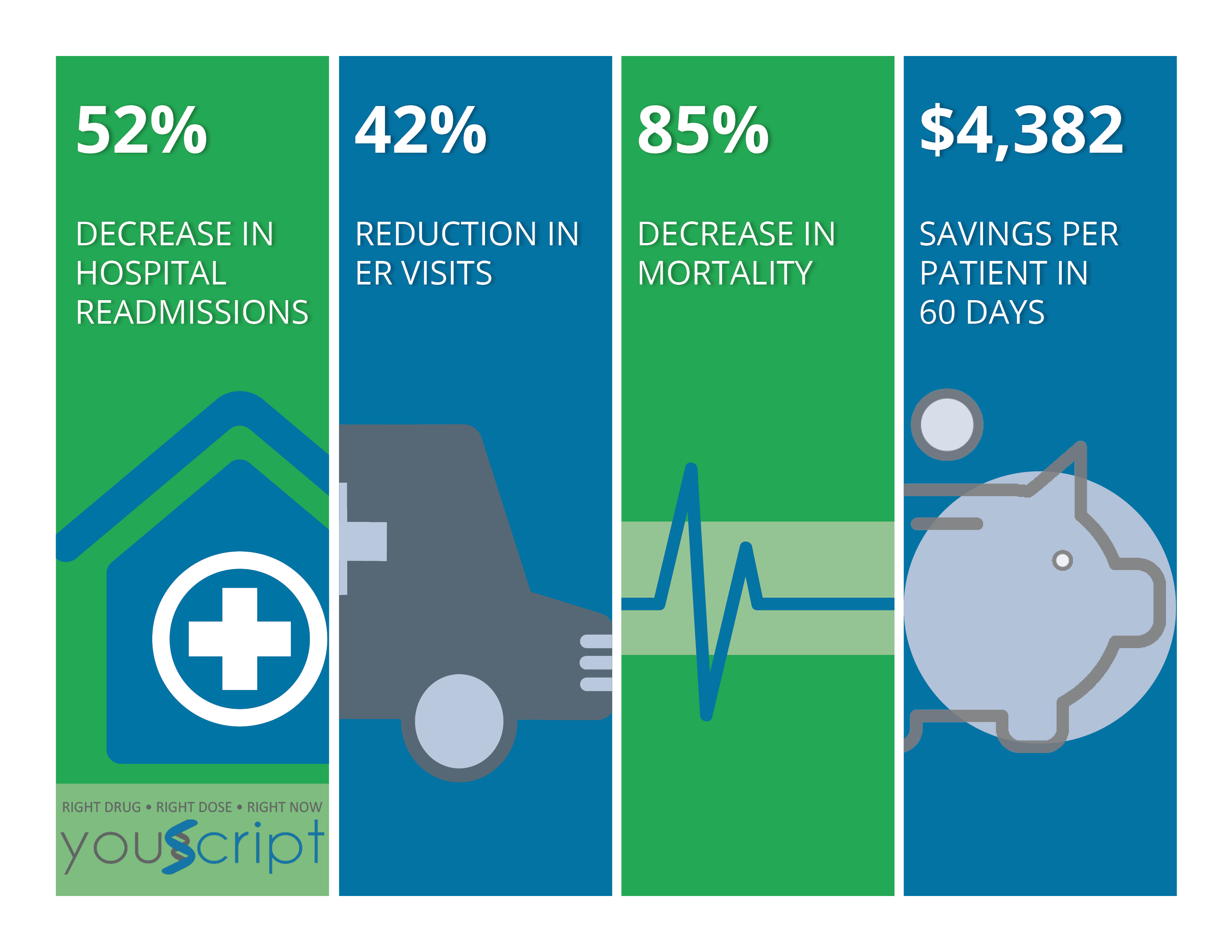
Seattle, WA — YouScript, a proprietary clinical decision support tool designed to assist in medication therapy management, has been shown to reduce readmissions by 52 percent (p=0.007) and ER visits by 42 percent (p=0.045) in patients over 50 taking multiple medications when combined with pharmacogenetic testing.

Researchers at Harding University and Unity Health-White County Medical Center, in collaboration with Genelex Labs, a pioneer in pharmacogenomic testing, and precision prescribing software company, YouScript, conducted a randomized controlled trial in a high-risk population of chronically ill polypharmacy patients aged 50 years and older admitted to home health care after an in-patient hospitalization. The trial was designed to incorporate pharmacogenetic data into an integrated clinical decision support system and compare the results to a standard drug information system.
Reductions in readmissions, ER visits, costs, and death
This study validates the results of the IMPACT study completed by the University of Utah in 2015 in which hospitalizations were reduced 39% and ER visits 79% in elderly polypharmacy patients in an ambulatory environment in 4-months. In addition to re-hospitalization and ED visit metrics; the new study examined secondary endpoints including death and Medicare administrative quality measures. Risk of death decreased by 85 percent (p=0.05) compared to the control group and researchers estimated a potential per capita cost savings of $4,382 based upon Medicare average all-cause readmission and ER visit cost in only 60-days. The results of the study were recently published in PLOS ONE.

“If reproduced across the entire Medicare home health population, this would save billions of dollars and thousands of lives every year. Not only does this meet the goals of the Triple Aim, but it brings to bear the question, when does it become a patient safety issue for this not to be part of the standard of care for polypharmacy patients,” said Kristine Ashcraft, CEO of Seattle-based YouScript. “We appreciate all the hard work Harding University has done and thank the patients at Unity Health’s White County Medical Center for their participation in this landmark study validating the power of precision medicine.”

The study examined two groups of 50-and-older home health patients taking an average of 11.6 prescription drugs. The mean Outcome and Assessment Information Set (OASIS) score for overall health at the start of intervention, drug count at baseline, and pharmacogenetic risk, the likelihood that testing would reveal substantial gene based drug interactions, in the tested and untested groups were the same. The study population was selected to have a higher than average return on pharmacogenetic testing defined by the likely frequency of drugs interacting with cytochromes or CYPs, enzymes in the liver that metabolize many medications. Drugs are currently prescribed assuming normal genetics for the CYPs when only 7% of patients are normal for all five of the main CYPs.

  • The tested group received a physician order for Genelex pharmacogenetic testing followed by a study pharmacist reviewing drug-drug, drug-gene, and cumulative drug and/or gene interactions in the tested group using YouScript generated reports and clinical decision support tool to provide drug therapy recommendations to clinicians, after which prescriptions were altered at clinician discretion.
  • The second group, a matched untested control group, received treatment as usual including pharmacist guided medication management using a standard drug information resource.

The primary outcome measures were the number of readmissions and ER visits at 30 days and 60 days after discharge from the hospital. These findings occurred in a Home Health Agency (HHA) that, according to 2015 Home Health Quality Improvement reporting was already in the 5th – 12th percentile CMS benchmark group for lowest readmissions.

Lindsay S. Elliott, Pharm.D., BCGP who was the primary investigator for the study noted, “All clinicians strive to improve quality of life for their patients. Knowing patient specific drug metabolism combined with the ability to identify cumulative drug-drug, drug-gene, and drug-drug-gene interactions will only aid in our efforts. This study demonstrates the potential to manage medication regimens specific to the patient in order to increase efficacy, decrease adverse effects, and reduce overall healthcare costs.”

The YouScript system combines comprehensive predictive medication management analytics with pharmacogenetic testing to provide an at-a-glance summary of how the complex web of medication and genetic interactions affect patient response to drug treatments. The patented software algorithms analyze patient medication regimens combined with genetic test results to predict the potential for adverse drug events and treatment failures. When potential problems are identified, YouScript suggests alternative medications with reduced interaction risk, taking into account all other relevant drugs, herbals, and genetic factors.

“Randomized controlled trials of integrated pharmacogenetic information in a broad polypharmacy population have been lacking. The data from this study offers a potentially important opportunity to minimize ADEs and reduce health resource utilization,” said corresponding author Ranjit Thirumaran, M.Pharm, Ph.D., Director, Clinical Pharmacogenetics at YouScript.

# # #

About Genelex
Founded in 1987, Seattle-based Genelex is one of the first clinical laboratories to provide pharmacogenetic testing and interpretation. Pharmacogenetic testing examines variations of the cytochrome P450 (CYP) enzymes. While there are over 50 CYP enzymes, approximately five contribute to the metabolism of over 80 percent prescription medications, herbals, and over the counter medications. The Genelex pharmacogenetic test reveals natural variations present in more than 90 percent of people that determine how the body processes commonly prescribed medications. As creators of the patented and proprietary YouScript Personalized Prescribing System, Genelex is a pioneer in comprehensive medication analytics and pharmacogenetic testing.
For more information, visit: www.genelex.com.

About YouScript
Based on fifteen years of technology development that makes precision prescribing possible, Seattle-based YouScript was founded in 2016 after spinning out of Genelex. The YouScript clinical decision support tool is the only medication management system available that assesses the cumulative effect of a patient drug regimen and unique pharmacogenomic results. Based on over 14,000 curated references and product inserts, YouScript uses comprehensive predictive analytics to interpret and provide an at-a-glance summary of the complex web of genetics, medications, over-the-counters, herbals, and other factors impacting drug safety and response; identifying at risk patients for testing and offering ranked alternatives with reduced interaction risk whenever an adverse interaction risk is found.
For more information, visit: www.youscript.com or HIMSS Booth #823.

Contact:
Jennifer Hayes
Phone: 206.826.1921
Email: [email protected]

PSYCHIATRIC PHARMACOGENETICS from concepts to cases Book Now Available

By Cytochrome P450, Genetics Research, News, Personalized Medicine, Pharmacist's Corner, Pharmacogenetics

Clinicians who treat psychiatric patients know that medications can be lifesaving, but they also know that these same potentially lifesaving psychotropic medications can have serious side effects. We now have a tool in pharmacogenetic testing that can help minimize medication side effects. Patients are increasingly requesting that their provider use this tool to help more accurately select a treatment, address poor treatment response and, probably most important, employ it when patients experience side effects. Most healthcare providers, however, do not receive the adequate training in pharmacogenetics to readily employ this technology.

Additionally, the accessibility of this technology to clinicians, residents, and providers who regularly prescribe psychotropic medications is often limited. To address these shortfalls, two distinguished leaders in this cutting edge field, Dr. David Durham and Dr. Ranjit Thirumaran, wrote Psychiatric Pharmacogenetics from concepts to cases. It is a very unique book in that it was designed for the busy practitioner in mind with succinct information organized in an efficient and well-organized fashion.

The book gives a synopsis of the history of how the science of pharmacogenetics evolved, how this new science can help address the mounting cost of managing adverse drug events, and explains the physiology of pharmacogenetics – the Cytochrome P450 system. The book also provide the readers with a good understanding of the epidemiology of Cytochrome P450 variability as it is one the most important pieces of informing to justify ordering a test.

This book is unique in that it is the first of its kind to dedicate a chapter on how adopting pharmacogenetic technology in clinical practice can markedly reduce medico-legal risk, and increase quality of care. It also dedicates chapters on the ethics and social impact of this rapidly advancing technology.

Finally, and certainly not least, this book provides fifteen detailed clinical cases selected from, patients out of private practices, to illustrate the clinical usefulness of pharmacogenetic testing for patients on psychotropic agents. The case studies are intriguing and useful and compel the reader to wonder why pharmacogenetics is not being used on a routine basis practice.

For the busy psychiatric practitioner, this book promises to advance their knowledge and skills by giving them practical information they can employ immediately.

Dr. Durham points out, “it is past time we use psychotropic medication as a scalpel, and not a broadsword. Through pharmacogenetic testing, we now have the means and the evidence of its effectiveness. We must gather the will to broadly adopt it.”

“The prevalence and burden of depression are predicted to continually grow and continued education in the field of psychiatric pharmacogenetics is important to its widespread acceptance. The benefits are evident as it would allow health care providers to tailor psychotropic treatment with the highest likelihood of success, thus steering in the era of precision medicine,” said Dr. Thirumaran.

Amazon listed Psychiatric Pharmacogenetics from concepts to cases as #1 new release in Genetics and the best seller in the Drug Reference Guide and Genetics category. Interested readers can purchase the paperback for $49.99 and e-book for $34.99 from Amazon, Barnes and Noble, Apple iTunes, Kobo, and Lulu. The hardcover release will occur in late February and the Audiobook is in development and will be ready by February 28, 2017.

This Month in Pharmacogenetics and HealthIT – January 2017

By News

Pharmacogenomics and Precision Medicine is trending like never before, with the strides that are being made in this field. While you can go and search out the news yourself, we want to make it easy for you. You can start by following social media platforms: Facebook, Twitter, Pinterest, LinkedIn, and our preferred lab partner, Genelex on Facebook and Twitter. We’re constantly posting relevant articles from around the web. Or you can follow our “This Month in Pharmacogenetics and HealthIT” series where we highlight some of the current trending articles. Here’s this month’s trending articles:

CYP Testing to Help Prevent Dangerous Adverse Drug Reactions

“Within minutes, a doctor can get a clear indication whether the medication he or she is about to prescribe can be a danger to the patient. If those extra minutes can save a patient’s life, they are well spent.”

PSYCHIATRIC PHARMACOGENETICS: from concepts to cases

Congratulations to David Durham, M.D., MPH and YouScript’s Ranjit Thirumaran M.Pharm, Ph.D., Director, Clinical Pharmacogenetics on publishing PSYCHIATRIC PHARMACOGENETICS: from concepts to cases.

UM doctors want more patients tested for gene variant that makes heart drug ineffective

Recent news coming from University of Maryland Medical Center continuing the dialogue that more patients should receive genetic testing before taking Plavix. We absolutely agree — we’re glad to see more health systems turning to pharmacogenetic testing and personalized prescribing.

Phoenix Children’s CIO says big data tactics reduce medical errors

“To protect the safety of our young patients, Phoenix Children’s Chief Medical Information Officer Vinay Vaidya, MD, led a team to develop a “zero-tolerance” dose range checking system. The goal was a lofty one: to eliminate 100 percent of overdosing errors at the prescribing stage.”

New Genetic Tests Help Personalize Depression Medication

Read on how pharmacogenetics testing and precision medicine helped one nurse overcome prescription side effects and find the right drug for her.